Showing posts with label Alzheimer's. Show all posts

Wednesday, September 2, 2015

Writing Alzheimer's: Tanya Ward Goodman & B. Lynn Goodwin

Alzheimer's and other forms of dementia have affected innumerable lives, including my own. My mom, a writer and a nurse, wrote about her dementia as her capacities diminished. And I wrote about my caregiving experiences in my journals, in innumerable emails to loved ones, on this blog--and ultimately in my memoir.

What is it about the intersection of illness, caregiving, and writing?
 
I recently read two books that address the creative fire's role in grieving, loving, and healing. I also spoke to both authors.

http://www.unmpress.com/books.php?ID=20000000005443

Tanya Ward Goodman writes in Leaving Tinkertown about the simultaneous decline into dementia of her father and grandmother. Astonishingly, the book isn't dreary. It's permeated with love and resilience.  As Tanya said, "Alzheimer’s disease is a huge tragedy, but my family emerged intact. We continue to love and create and connect and that is not a downer."

In the book, the portrait of her father made me wish I'd known him. Ross Ward was a "consistently creative person," said Tanya, a man whose "curiosity and enthusiasm about the world was contagious."

He was a unique thinker and a free spirit who built Tinkertown Museum, a roadside attraction outside Albuquerque, New Mexico.


In the book, Tanya explores the awful losses associated with dementia--but she also addresses how some of the changes can be surprisingly positive. Her father's "sense of wonder and excitement was in some ways deepened," and she describes the disease as "loosening" her grandmother. I found this to be true for my mom, too. As she lost her language, I was able to massage her and hold her in ways she might not have enjoyed before. We developed a new kind of closeness.

Tanya said that spending time with her dad and grandmother encouraged her "to slow down. At the beginning, this was incredibly hard" because of all that caregiving requires. "Eventually, though, I let myself go along with Dad and Gran as much as I could. They relaxed because we weren’t always correcting them or trying to force them to remember and we benefited from the intimacy."

Tanya Ward Goodman (photo by Doug Piburn)
She added that with her father, "it was fun to gather rocks or watch the dogs sleeping in the sun. We spent a lot of time going over his scrapbooks. He’d tell me the same story again and again, but it was comforting to us both. As his disease progressed, my operating mantra became, 'why not?' I indulged him. It wasn’t going to kill him to eat a pint of ice cream for dinner. It wasn’t going to break the bank to buy a roll of sparkle stickers. Sure, we didn’t need more art books, but they made him happy, so why not?"

I was especially struck by her take-away: "I try to continue to live this way. Life is short. Spend real time with the people you love. If you want to do something or go somewhere and you can figure out a way to make it happen, why not?"
 
Tanya didn't set out to write a book. At first she wrote essays to sort through her feelings. She also kept a sporadic journal and wrote long emails to her boyfriend. Later, she sorted through all of that and the book emerged. 

"I kept asking myself 'what is the story? What is my story?' To that end, my biggest advice to memoir writers, or any writers for that matter, is to keep writing. Write everything you can think to write and then pare it down. Getting lost is, for me, a way to find a true path."
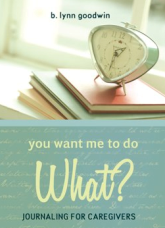

http://www.amazon.com/You-Want-Me-Do-What/dp/1606962973/ref=sr_1_4?s=books&ie=UTF8&qid=1441224690&sr=1-4&keywords=you+want+me+to+do+what
Whether or not you are going to write a book, B. Lynn Goodwin--author of You Want Me to Do What?: Journaling for Caregivers--encourages caregivers to write because "writing relieves stress rather than creating it. It allows a caregiver, or anyone, to vent without hurting someone's feelings." Writing, said Lynn, can help us see that we are not alone. It allows us "to process, dig deeper, get to the truth, plan strategies, and find solutions." Lynn pointed out that caregivers are not the only ones who can benefit. Her book could easily be titled, Journaling for Everyone.

B. Lynn Goodwin
I like the book's evocative prompts, such as: "Today I hope...", "I can barely remember...", "I lust after...", "Chocolate always...", "My life changed when...", and "At the edge of my heart..."

"If you start with a prompt, you never have to face a blank page," said Lynn. You can "finish the sentence and let the writing take you wherever you want to go or need to go."

Writing helps us grapple all that it means to be human. And in the very act of writing, we feel the power of its generative force. It is life giving.


Tanya Ward Goodman writes for The Next Family and lives in Los Angeles. She is working on a novel about becoming a mother. Visit her website.

B. Lynn Goodman is the owner of Writer Advice. She conducts workshops and writes reviews for Story Circle Network. Her young adult novel, Talent, will be out November 1, and she is currently working on a memoir about getting married for the first time at age 62.

Friday, May 3, 2013

For Mother's Day


Mom in her 20s (circa early 1950s), when she was a nurse in Hawaii.

With the first Mother's Day approaching since my mom stepped to the other side last August, I've been thinking about what a cool person she was.

After nursing school, she worked in Hawaii as a nurse before it was a state.  Her next job was as a nurse in Yosemite, where she met my dad. 

Later, she became a school nurse.  In that role, she taught a Sex Ed class to middle-schoolers. The kids wrote anonymous questions on cards, which she’d pull at random out of a box:

What’s an orgasm?
What do two men do when they have sex?
Can you get pregnant if you have sex standing up?

Mom would answer these questions straight-faced and seriously. I'm sure her deportment conveyed to the kids that all these taboos they giggle about, yearn for, and worry about are no big deal. They’re just part of life.

In mid-life, she took up piano lessons.  And then, with even more passion, writing.

Most evenings after dinner while Dad cat-napped in front of the TV, Mom sat before her computer. One of her first articles—“Is Your Child Ready for Kindergarten?”— came from her knowledge of screening kids for school readiness. Mom researched freelance writing, reading numerous books on how to write articles, how to publish them, how to market yourself.

Later she wrote many other articles and two books about Color Blindness (which she screened kids for as a school nurse).  Still later, she wrote stories, and then romance novels.  Her love for science and California crept into her fiction.

My favorite is Love’s Golden Song, a historical romance that takes place in the Gold Rush era.  The heroine is a spunky, ahead-of-her-time newspaper reporter who decries hydraulic mining; her nemesis, who becomes her love interest, is—of course—a hydraulic miner. Mom did a lot of research to write this book, and the authenticity of the details is a pleasure to read.

That one was never published, but another one was:  Dinner For Two. Taking place in the Northern California towns of my youth, it’s about a woman named Misty, her love-interest Gene who is a colorblind (!) chef, and a mystery they get embroiled in involving food poisoning at the state capital in Sacramento.

I'm glad my mom got to use her mind so much before it began to drift to another plane due to Alzheimer's.  I'm grateful we were able to spend so much time together as she shifted and changed, while she still had language.  Until she couldn't write anymore, she kept a journal about what Alzheimer's felt like.

Eventually she couldn't speak anymore.  Given how much we used words as writers and consummate communicators, this lack of language shifted our relationship onto a new plane.  It became about presence.  Eye contact.  Energy.  Touch.

My mom is still very much alive in me.  From her I've inherited a love of travel and writing and laughter and mentoring. 

I know she wants me to thrive.  I can feel her rooting me on. 

Wednesday, March 20, 2013

Affecting Eternity: Thoughts Upon Leaving Teaching

Teachers affect eternity.  They never know where their influence ends.  - Henry Adams


*

When I was student teaching high school in the mid 1980s, a student asked me to the prom.   That's how young I was.  (I told him he had to wrap his mind around the fact that I was his teacher.)

*

When I was student teaching in a middle school, I was so baffled about how to fill up a 50-minute class session that I read aloud all of Call of the Wild to the students.  That took at least a week.  (Who knew one day my sister would marry Jack London's great-grandson?)

*

When I was teaching in Japan and my six little charges couldn't sit still another minute, I'd do one of two things:  1) Turn on Madonna's "Holiday" and dance with the kiddies around the room, sing-shouting the lyrics together, or 2) Take out a long rope, tell each kid to hold onto one of the knots interspersed down the length of the rope, and then take them on the three-block walk to a convenience store where each could pick out one snack item, as long as they asked for it in English.

*


"I aspire to try to be a teacher to my young fans who feel just like I felt when I was younger.  I just felt like a freak.  ... I want to free them of their fears and make them feel that they can make their own space in the world." - Lady Gaga

In one of my frosh comp classes, students were writing about important events in their lives.  One guy wrote about going to a Lada Gaga "Monster's Ball" concert wearing exactly what he wanted to:  a sparkly blue dress.  He was scared at first, but then dancing to her music made him feel more and more brave until he felt, bursting with happiness, that he was one of her "little monsters."

*

In my Queer Arts course, one girl in the class talked about how she came out as a lesbian as a sophomore in high school, and then was elected homecoming queen her senior year.  We loved looking at her yearbook pictures of homecoming:  the homecoming queen, escorted by her girlfriend.

*

Last August, on the first day of the semester, I checked my phone during class break.  My sister had called to tell me my mom had passed away.  I knew it was coming.  Mom had Alzheimer's and hadn't spoken in over a year.  Two days prior, I'd spent the day with her.  Lying next to her on her bed, I massaged her, I played Hawaiian music (her favorite), and I talked to her about all my good memories of my childhood.  I also told her the new semester was starting.  A retired school nurse and writer, she liked that we had in common educating and writing.  Perhaps that's why, after the break, I finished teaching my class.  I was kind of numb but I couldn't think of what else to do.  I didn't have my car with me (I'd taken the bus to work), and Mom was in good hands with my sisters 45 minutes away.  I told my T.A.--a graduate student--what had happened, just in case I needed to step out.  I made it through the rest of class.  Afterward, my T.A. said, "I'm so sorry about your Mom, Kate."  I looked at his young face and thought about how sweet he was, and how being in your twenties is a different animal than being in your 40's.  Then he said, "I understand what you're going through.  I lost my mom when I was ten."  As we walked across campus, he told me the story of her illness, of his taking care of her.  What a gift he gave me that day--a reminder that we all have losses in our lives, and that some of us have our mothers longer than others. 

*

"It is the supreme art of the teacher to awaken joy in creative expression and knowledge." - A. Einstein


My mentor Gabriele Rico--the woman who sparked a flame in me for teaching, for writing, for poetry--died last week.  Everything I do is "stitched with her color."  My office is in the building where hers used to be.  I often feel her presence in that building, and in the classrooms where I teach.  Especially when I'm having my students do clustering or re-creation to awaken their inner geniuses. Gabriele believed everyone had powerful potential.  Her life was devoted to inspiring people to let their unique creativity shine. 

*

I'm retiring from teaching this year.  It feels like such a fitting time.  Recently I came across this "Love Letters" website and thought about how I would use it in a writing class.  This is how my mind has worked for years:  everything I encounter gets sifted through the how might students respond to this filter.  I sent an email to a group of my teacher friends telling them my ideas and giving them the link, and several wrote back enthusiastic about this new teaching idea.  One wrote:  "Oh Kate, you'll never stop teaching, a very good thing."

*

During my first year of teaching high school, I saw a former English professor of mine who had been so enthusiastic and knowledgeable about Hemingway and Fitzgerald that I couldn't help but fall in love with them.  In fact, I had just taught "Hills Like White Elephants" and felt like I knew how to hook students into the story because of his teaching.  I had an impulse to run up and say something, but I wavered.  And then I thought, what the hell and did it.  I could tell it took him a minute to remember me.  And then I told him he'd had a big influence on me, which had enriched my teaching.  To my surprise, his eyes misted.  Then he said:  "Well, this is interesting timing.  I was just going to sign my retirement papers.  And before you stopped me what was going through my mind was this:  I wonder if what I've done all these years has really mattered."

*


Here's an email I received last week from a former student:  I hope you remember me. ... I haven't seen you in quite some time, so I would like to offer my congratulations, as I know you were recently married! ... I am thrilled for you! Kate, you may not realize, but you have taught me so much about what it looks like to be an individual, to be unique, and to be comfortable in my own skin. My growing process could not possibly have been complete without your encouragement along the way, so thank you from the bottom of my heart.


*

Sunday, March 3, 2013

The Trip of a Lifetime


Our family, circa 1990

I'd been wanting to write about this for quite some time, and being invited to read at The Celebration of the Muse prompted me to do so.  It was a joy to share the stage with twenty local women writers.  The evening was a display of heart and talent.

The poem is about my parents.  It's about angels.  It's about dying as a transformation.  My mom and my dad each had their own path--and they continue on their own journeys. 


The Trip of a Lifetime

1)

My dad has become much more spiritual

since he’s become a spirit.  Maybe his blue eyes

and handlebar mustache signaled he always had angel

potential.  He’d been gone only three months

when, as I sat at the computer, he—

I don’t know how else to put this—

came over for a visit.  My body filled with

a warmth I recognized as him.  My fingertips

froze on the keyboard.  I resisted saying,

“Hi Dad!” because I worried he’d

evaporate if I spoke or moved.  A

softening cupped my heart.  He spoke

without language, filling me with this message:

Everything’s fine.  Fine as in whole, as in

flawless.  Fine as in don’t worry—as in lovely

and pure.  As fine as the sand on an endless beach

that spreads toward the eternal horizon. 

A few days before he died, he said if the afterworld

was real, he’d find a way to pinch me. 

This wasn’t a pinch, though.  Maybe spirits

don’t have fingers.  I remember Dad’s fingers,

thick fingertip pads that fumbled as he

turned newspaper pages.  Yet he grasped a hammer

so resolutely that he built redwood decks in record time,

laid down railroad ties and hauled thousands of

buckets of firewood.  He’d always slide

his ring back on after his shower, before dinner.

2)

A week after the funeral, Mom and I found

Dad’s wedding band in a drawer

next to the bed, gold and round as a tiny halo. 

“Toss it,” Mom said.  All afternoon she’d been saying

“toss this, toss that” about most of Dad’s things. 

The geriatric psychologist asked my mom:

“In what way are a rose and a tulip alike?”

 Mom said:  “They are not alike.”

He said:  “How are a watch and a ruler alike?”

She said:  “They both measure time.”

“A bike and a train?”

“They are both machinery.”

“A corkscrew and a hammer?”

“I don’t know.”

He asked:  “What would you do if there was a fire in your house?”

She answered:  “I’d close and lock the doors.”

“Patient described as showing a change in cognitive status. Her husband of 48 years passed away two months ago.  She worked as a school nurse for many years but doesn’t recall when she retired.  Patient is a poor historian.”

3)

The doctor wrote:  “Patient is a poor historian.”

Pablo Neruda wrote:   “Love is so short, forgetting is so long.” 

4)

Hospice literature says:

“One week before death,

the average patient

still has

a 40% chance

of living.”

It says:

“There is no medical definition

of terminal.”

It says:

“There is no medical definition

of  dying.”

5)

The next time Dad popped in for a visit

I was jogging through my neighborhood. 

“Wow,” he said without words, “Look, look,

look, look, look!”  As my feet metronomed

on the pavement, the colors brightened.  And I saw

through new eyes the crystalline winter day,

the razor-sharp infinite blue of the sky, and the

preposterous fuchsia blossoms as unabashed as the sex of

the world.  Mom gave me the same gift once:

a ViewMaster in my Christmas stocking. 

I’d spent hours peering in,

atingle at the Wonders of the World in 3D—

azure seas and golden windows, lush veils and drapes

and rushing waterfalls—places my mother dreamed of.

6)

Mom began to leave long before she died.

Her language left word by word

as though she was packing a suitcase.

She hadn’t spoken in almost a year.

But when I showed her my engagement ring—

sapphire blue like my father’s eyes—

she reached out and touched my face. 

She doesn’t visit.  I can still feel the release

of her last exhalation, like the lift of a plane.

She’s off on the trip of a lifetime.


*


For more about my mom:

For more about my dad:


Sunday, September 2, 2012

"True humor's essence is love." - Thomas Carlyle


My mom died last week.  Because of her dementia, she hadn't spoken in over a year.  The last word I ever heard her say was "yes."  In fact, that was the only word she used for quite some time.

No language, but a big smile.
Another thing she did for a long time after losing her language was laugh.  When someone cracked a joke, she'd grin--even though it didn't seem possible she understood it.  And as it had throughout the years, America's Funniest Home Videos continued to make her giggle.

Taken a few years ago at Christmas.  Mom thought this was a hilarious picture.
My mom always loved to laugh.  Especially at self-deprecation and irreverence.  Five years ago--after my father had died and she'd not only been diagnosed with Alzheimer's but had fallen and broken her arm and spent months in and out of the hospital because of various maladies--she was staying at my house for a while.  I put on Monty Python's Life of Brian, ready to turn it off if it was just too much.  But mom laughed the whole way through.  We howled with laughter together at the end--you know, the scene when the crucified men merrily sing from their crosses:  "Always Look on the Bright Side of Life."

Mom as a young nurse in Hawaii.
Soon after her diagnosis, she told me she'd been considering suicide.  I told her no one wanted her to do that--that her death journey was part of her life, and we'd all be in this together.  Later, she shared that with a longtime friend of hers, also a former Catholic.  The friend--who also had struggled with illness--said, "I've thought of that too but I'd have no idea how go about it.  Besides, isn't suicide a mortal sin?"  She and her friend laughed hard over that.  And my mom totally cracked up when she shared the story with me.  Sometimes we'd kind of cry and laugh at the same time.


Years later in Hawaii, with her daughters and her favorite drink:  a Lava Flow.


I'll never forgot her 70th birthday, nine years ago.  We had a family party.  When it came my turn to toast, I said: "I'm glad you've lived long enough for me to appreciate you."  She roared!  And whenever I reminded her of the line, she laughed again, like it was the first time she'd heard it.


Our longtime family friends Gary and Laurie wrote a beautiful letter to my sisters and me telling us they can still "hear her laughter rising in the California foothill sun."  

Yesterday I said to Dave:  "When the day begins with paying bills and writing your mom's obituary, you know things can only go up from here."  She would have loved that line.  In fact, I think she did.  Her laugh seemed to echo off the kitchen walls.

They loved nature.  And they were great dancers.  I think they're now foxtrotting in the stars.
Gary and Laurie characterized my mom perfectly as a "gentle soul with toughness and resolve who not only performed the art of motherhood as well as any we’ve known, not only served as caregiver to her husband for decades but here was a woman who allowed her own personhood to blossom beyond her life duties. ... Hers was a special beauty." 

They added:  "She saw you grow and settle, she experienced the future of her DNA as she enjoyed her beautiful grandchildren, she drank deeply of a marriage, friends and the recognition she received as a vital professional and community member.  Most never live so much life."

No one is ever really gone.  All we have to do is think about them and they can be right there.  I've had great conversations with my dad during the five years since he passed.  And I know I will with my mom, too.  I think there will be more laughter.


Mom in her beloved Yosemite, where she worked as a nurse and met my dad.

Wednesday, October 8, 2008

Friday, May 9, 2008

Writing about life with Alzheimer's

Mom is keeping what she calls a journal of her symptoms. She's writing about what it feels like to have Alzheimer's. I'm glad she's still writing and reading, even though both are hard for her.

She struggles with spelling and also, as she wrote in the diary, with the "nooances" of what she reads. That's the amazing paradox of this disease--that she can still understand the idea of nuances, even though she's losing the capacity to capture them and to spell the word.

When I was with her the other night and she was emailing a friend, she asked me how to spell "Lois," "once" and "couldn't." This from woman who has written (and published) books. She knows when she has spelled something wrong, but she doesn't know how to fix it. It gets very frustrating for her, but we both try not to dwell on the surreal quality and sadness of what can't be healed.

We went out to dinner the other night she told me that the last thing a person says before a pause in discussion echoes over and over in her mind. I told her that I'd better make sure the last thing I say to her is always something nice, like "Mom, you look so thin!" or "Mom, I love you."

Alzheimer's manifests differently in different people. "Forgetting" isn't just about forgetting events; it can involve forgetting how to function, how to achieve operational tasks, like how to spell a word or how to--as happened to Mom the other day--open a car door. These things are like burps in cognition, things that are almost indetectable for people who aren't looking closely or who don't know her very well.

Mom lives in an assisted living community where every day she is involved in numerous activities, such as walking, excercise classes, outings, movies, communal meals. She loves to laugh. She enjoys being with her daughters, grandkids, other family and friends. She likes to keep an eagle eye out for problems at the place where she lives; she keeps a list that she shares at the resident's council meeting. Before this, I'd thought of Alzheimer's Disease as a death sentence. It's not, really. People can still have a good quality of life even as their brains change. Many people are living with Alzheimer's Disease, not just dying from it. That is the "last stage"--but there's a lot of life to live before that happens.

The fact is, Mom is a very bright, educated person. She can "cover" or "cope" very well--and so what I see when I'm with her, I know, is just a little bit of what it feels like to be inside her mind. That's why I'm glad she's getting it all down, as best as she can, in the journal. She told me I can do whatever I like with her journal. She likes the idea of my sharing the story from both of our perspectives. She has always been a supporter of my writing. And I of hers.

Monday, March 31, 2008

Truth ... And my given name

"As soon as a [writer] stops observing . . . he becomes an evangelist, a politician. A person with Opinions. . . . The [writer] must be on the side of life, willing to surrender his 'beliefs' even . . . When one believes he has the Truth, he is no longer an artist."


from this book by Joyce Carol Oates

*

Yesterday I got an email from Mom telling me that she almost forgot how to spell my name, Kathleen, the name she gave to me 45 years ago. She wrote, "I guess that's what to be expected, but that doesn't make it any easier!"

Given that Mom has mid-stage Alzheimer's, I'm continually amazed at how aware she is of what she's losing.

As one geriatric specialist said, Mom is a smart, accomplished woman. Some people who are at her stage might be more debiltated; she might be losing a lot, but she still has a lot to work with.

That said, I'm trying not to obsess over every detail of her disease. Instead, I'm trying to enjoy every moment we have together. Tomorrow we'll go to my sister's house, eat pizza, and watch Idol. My nieces and nephew will be running around, and we'll embrace all we have. And we do have a lot: love, the present moment, and each other.

Wednesday, March 19, 2008

Spring and the Interior Year

I'm really enjoying my students this semester. So many of them are full of ideas and questions and opinions and energy. They are supportive of each other's writing, and they are gelling as a group.

I've taught classes in the past that I've dreaded attending (yes, students aren't the only ones who dread going to class sometimes)--but I don't feel that way at all this semester about either of my groups. I feel lucky.

*

Spring break is next week. Lots of writing time. I think it's possible I might be able to do a lot of work on a memoir piece I'm working on. The memoir is about the phenomenon of "caretaking" for ill and elderly people. I write about the long-term illness and death of my father, followed almost immediately by my mother's Alzheimer's diagnosis (as well as other "caretaking" stories, such as Annie's caring for her ill mother, and my mom's caring for her parents and my father).

My working title is: Seams of Our Interior Year: A Memoir of Caretaking.

The title comes from a line by Rilke's Duino Elegies:

We wasters of sorrows!
How we stare away into sad endurance beyond them
trying to force their end! Whereas they are nothing else
than our winter foliage, our sombre evergreen, one of the seams of our
interior year—not only season—they’re also place, settlement camp,
soil, dwelling.

Friday, December 7, 2007

Flu Reading

The first year I don't get a flu shot in a long time and what happens? I get the flu. It's been a forceful one--four days of a sore throat, more than a week now of weakness and headache, and a relentless wet cough in my aching chest.
I've used the flu as an opportunity to read some of the books on my bedstand that I've been wanting to read for a while.

I obviously don't need uplifiting reading when I'm sick if I'm willing to pick up a post-apocalytpic novel. I read Cormac McCarthy's The Road in a day and a half, my skin crawling the entire time. I was let down by the ending (ending a novel is so tricky) but overall, I was electrically unsettled and wholly transported.

Since my mother's struggle with dementia, I've been wanting to read some memoirs about how people live through these experiences. Death in Slow Motion by Eleanor Cooney is--with its apt but oddly treacly title--fantastic. If you like a good memoir, this book is worth reading even if Alzheimer's isn't touching your life. Cooney's mother was an amazing woman whose life story would have been worth telling even without the epically tragic end. Her mother was a unique thinker, a spirit, a fascinating person, and a terrific writer--and Eleanor inherited the writing gene. The book is in no way maudlin. It's honest, clear-eyed, witty, loving, irascible and intelligent. (And this book has a great ending, one I'll never forget.)

Thomas DeBaggio's Losing My Mind is written by a man with Alzheimer's. It's a fascinating, devastating book. I listened online to a few of his NPR interviews as well. He wants to take the taboo out of the disease. He wants people with the disease to state out loud that they have it and to tell people what it's like. He thinks this will help propel a cure. Amazingly enough, he wrote a second book after this one, which I have on order. I learned that now, however, he no longer reads or writes. He is able to speak a little, and he lives with his wife. Every day she takes him to the family-run nursery where he sees his son and the plants he grew for many years.