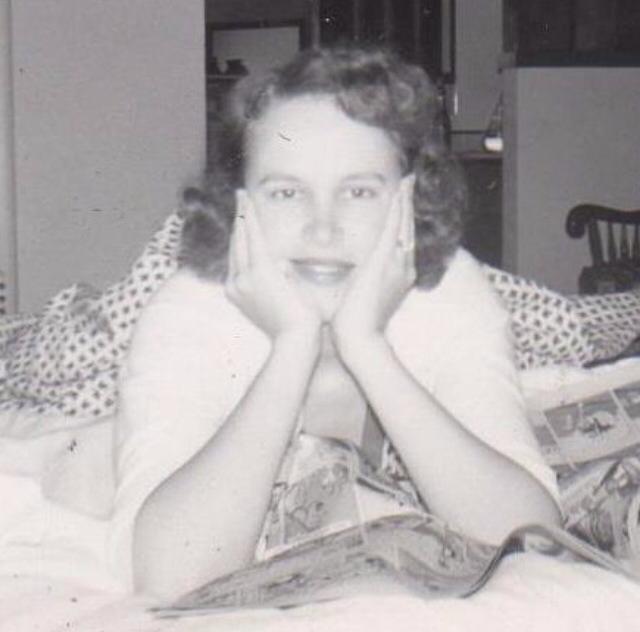
Showing posts sorted by relevance for query mom. Sort by date Show all posts

Sunday, May 11, 2008

Happy Mother's Day

For Mother's Day, here's a section of my in-progress memoir about my father's death and my mother's Alzheimer's diagnosis:

Two years before Dad died, Mom joined Toastmasters. Mom had never been that comfortable talking in front of people. She and Dad socialized a lot, but Dad was the talker; she was more comfortable listening.

She told me she admired my gift of gab, that I took after Dad. In her diary, I discovered that she viewed me as bright; I’d been tested with a high IQ. She had secret ambitions for me. She hoped I wouldn’t squander my intelligence.

What shocked me the most was to find out that she didn’t feel as intelligent as she thought I was. She wished she were smarter. This woman who got straight A’s in high school, this woman who completed more than six years of college, who was an R.N, a school nurse and a highly respected member of her community.

I am a novelist and a poet. Over the years, Mom tried to read my poetry but felt she never “got it.” Many people feel that way about poetry. It’s too obscure; what’s the point?

I tried to explain to her that I like the way poetry expresses nuances and ambiguities. As Stanley Kunitz says, poetry teaches us that we can believe two contradictory things at once. Poetry uses words to get at what cannot be expressed in a linear way. Language and understanding are unstable. A poem makes a non-summarizable feeling zip up my spine. I revel it its metaphorical expression; it makes me feel understood. It made me feel there are juicy prospects in every word. Poetry is possibility.

Mom may not like poetry, but she has always been drawn to novels and books of nonfiction. When I was an undergraduate English major, she read my required books so we could talk about them. The books in my Contemporary American Literature class she found self-indulgent and depressing and plot-less. She thought John Updike bordered on pornography (this from the woman handed over to me Fear of Flying when I was in high school). But she read them all with the studied objectivity of a medical student.

Mom once said something ironic that I now think was quite astute: “The difference between a mainstream story and a literary one is that literary stories don’t have endings.”

There was a chasm between my mother and me. She liked mainstream literature, I liked literary. She was pragmatic, I was idealistic. She inhabited a low-grade quietness, I a chatty exhiliaration. Even though she might roll her eyes at me or tease me about my energy, she was drawn to my quixotic impulses. She simultaneously rejected and was attracted to my reveling in metaphor and optimism.

She’d once entertained Catholic and catholic dreams about saving the world, of doing something like working with Father Damien and the lepers on Molokai. Perhaps she saw in me both the abandonment of those dreams and the potential to play them out.

If she wasn’t going to achieve her dreams of saving the world, she was going to allow herself time to develop a personal skill that wasn’t about taking care of others. She supported the Equal Rights Amendment and while cooking wore a denim, unisex apron emblazoned across the chest, “E.R.A. Yes!” This apron implied, I might be cooking, but I’m not just a cook, a mother, a helper of others.

When she was in her 40’s, she embarked on piano lessons, telling us she’d forced us to play piano as kids when she was really the one who wanted to. All those maddening years of hearing us practice the opening bars of “Fur Elise” over and over hadn’t turned her off to the piano.

My sisters’ and my piano teacher, Mary Bunyan, was the wife of a friend of our father’s. A short, rounded woman with a pretty face, she reminded me of a gentle grandmother from a fairy tale. The journey to her house was a fairy tale adventure itself. We had to walk a few perilous blocks. The first hazard on the route was a mere three doors down: Jigs, the meanest dog in the neighborhood. We’d walk as far as possible on the other side of the street, our feet gripping the contours of the concrete berm. (There were no sidewalks on our street. The houses were built on large lots crammed with oak trees and manzanita.) If we were lucky, Jigs would be tied up; he would lunge and howl and snap, straining the rope tied to his collar. If we were unlucky, he’d be loose. Sometimes he’d barrel across his lawn, screeching on his brakes at the perimeter of his yard, recklessly barking, spit flying from his mouth, his evil pointed teeth flashing yellow. Other times he’d charge across the street and snip at our heels and calves as we ran. We knew if we made it just a few houses away, he’d make a u-turn and silently trot back to his yard.

The next difficulty on the way to piano lessons was the Hill From Hell. This hill looked like one drawn by a child with a crayon, almost perpendicular, populated by houses defying gravity. Adults easily zoomed up the Hill From Hell in their cars, but no kid could conquer that hill on a bike, and walking it made your calves burn. Our town, in the foothills of the Sierra Nevada mountains, undulated with unreasonable hills. When I read my Archie comic books, I’d yearn for the ease with which Betty and Jughead and Archie walked across their flat town, to the malt shop, to each other’s houses. Walking across my town was grueling, as was walking even a quarter mile to Mrs. Bunyon’s.

Mrs. Bunyon taught my sisters and me how to read music and perform scales to a relentless metronome. Our practice pieces were watered down versions of Bach, Brahms, Beethoven. If we perfected one of these diluted classical masterpieces, we’d be rewarded with a contemporary piece, “Close to You” or “Joy to the World.”

I don’t know why my mom didn’t choose Mary Bunyon as her piano teacher. Maybe Mrs. Bunyon taught children only. My mom’s piano teacher was much more unconventional. Mom would come home from her lesson with armloads of photocopied sheets displaying the bass and treble clefs on which she was to pen musical notes. She was plied with theory about chords and encouraged to improvise. After hours at the piano, Mom might begin to play something with a recognizable melody. She’d pause and notate on the sheet music. I felt like she was learning a completely different instrument than I’d been taught.

Like me, Mom eventually quit the piano. Maybe if she’d had my piano teacher and I’d had hers, we’d both be at it.

Relinquishing music, Mom turned to writing. Most evenings after dinner while Dad cat-napped in front of the TV, Mom sat before her computer. One of her first articles—“Is Your Child Ready for Kindergarten?”— tapped into her knowledge of screening kids for school readiness. Mom researched freelance writing, reading numerous books on how to write articles, how to publish them, how to market yourself.

“Is Your Child Ready for Kindergarten?” was published in various versions in many different local and national newspapers and magazines. This led to other health-related articles, followed by human-interest articles. She wrote a piece about a couple who were driving on an icy road at night and were hit by a semi. The husband, alive and virtually unhurt, was trapped with his mortally-wounded wife. He touched her head, stroked her hair and talked to her as she died. He had shifted in his understanding of that event; what had once seemed a great tragedy now seemed a blessing. He had helped his much-loved wife feel safe and loved in her dying. Mom said the article was too emotionally draining to write. She never wrote a piece like it again.

She said the same thing about a short personal essay she’d written for an assignment in an adult education writing class. The assignment had been to write about a personally meaningful object. She wrote about the plate she owned that had belonged to her grandmother. In the piece, she wrote about how the plate represented her love for her grandmother. As a child, she’d perceived her beloved grandmother as dowdy and ancient. On the back of the plate is the maker’s mark, topped with a stamp of a tiny gold crown. The piece ends with this lyrical sentence: “I wish I could place that crown on my grandmother’s head.” That was the most symbolically powerful line my mother ever wrote. I find it very moving. She must, too, because even mentioning the story about her grandmother makes Mom’s eyes fill with tears.

She never wrote another emotional, personal essay. Mom was not a crier; she did not like to indulge her emotions. She moved on to writing romantic fiction, stories about lost loves reunited, about misunderstandings morphing into epiphanies. She researched romance magazines and placed a few pieces. She joined the Romance Writers of America and learned the formula for writing romances. Never a reader of romances, she began to read them as research, the covers bursting with cleavage and chiseled biceps. This was pragmatic investigation. She wanted to understand how a romance was written. “If I’m going to write a novel,” she said, “I need a road map.”

She wrote a romance novel. And another. And another. My favorite is Love’s Golden Song, an historical romance that takes place in 1860s California, a time period when men shot huge blasts of water to wash away mountainsides in their quest for untapped gold. This hydraulic mining devastated the environment, clogging up waterways, forever altering the geography of Northern California. In Love’s Golden Song, the heroine is a spunky, smart, ahead-of-her-time newspaper reporter who decries hydraulic mining; her nemesis, who becomes her love interest, is—of course—a hydraulic miner. Mom did a lot of research to write this book, and the authenticity of the details is undeniable and a pleasure to read. Some actual historic characters make an appearance, such as Lola Montez, famed for the titillating Spider Dance that she performed in Gold Rush theaters.

Romance novels aren’t my cup of tea, but I liked connecting to Mom through writing. I read and edited several of her novels, enjoying the experience. I also learned from Mom’s pragmatism how better to take criticism myself as a writer. She never justified any of her writing in the face of my suggestions. She just took what she wanted and left the rest. And she was always grateful that I spent time on her work. (She also once said to me something that I'm very grateful for, something it seems to me only a mother who is also a writer might bother to offer up: that I should always write about what I want and never worry about how she'll feel about it.)

Love’s Golden Song was never published. Another of Mom’s romance novels was, though, after Mom retired from school nursing and had more time to send queries to publishers and agents. Her self-proclaimed “romantic comedy,” Dinner For Two, was released by a small press. Taking place in the Northern California towns of my youth, it’s about a woman named Misty, her love-interest Gene who is a chef, and a mystery they get embroiled in involving food poisoning at the state capital. Gene is color-blind in the story.

Color-blindness, or CVD (Color Vision Deficiency), was another interest of my mom’s. As a school nurse, she’d diagnosed a number of students with this common disorder. She often spouted off the statistic that CVD affects one in twelve boys, but many fewer girls due to its residence on the X chromosome. Because females have two X chromosomes, they need to have both chromosomes affected in order to display color-blindness; not so for males.

Mom discovered there was no literature for the kids, parents and teachers to read about the genetics of CVD and about the ways it affects one’s perceptions, experiences and life choices. Upon retirement, she wrote two books on CVD, one for kids, and one for teens and adults. Illustrations were provided by an old friend who drew a weekly comic strip and political cartoons for the local paper. (He was also a former city councilman and mayor, and the father of one of my high school friends.) Another friend of Mom’s, a graphic artist, designed the book and the cover.

After trying in vain to find an agent or a publisher, Mom self-published these books and spent many more hours on PR than she ever had on writing. She read book after book on marketing. She wrote articles on CVD that mentioned her books (free PR); she sent mass mailings to schools and doctors’ offices; she spoke at the Lion’s Club and the Rotary and to parents’ groups and groups and at church groups; she was interviewed on a Sacramento morning news program.

All of this talking was painful for her. She hated public speaking but was determined to get out the news about her books. However, as time went on she struggled more and more to articulate what she wanted to say.

We all noticed this “word problem” in Mom. If her language skills were deteriorating, the decline was so incremental it was hard to tell if her inability to speak fluidly was progressive, or if it was just her nature. When she was under stress or pressure, it seemed her struggle for words got worse. Was this a new thing, or had she always been this way? I could feel her embarrassment rise while she groped for words. I understood that flush of embarrassment. I had to work hard to be fluid with my language when I felt someone was challenging me or was asking me to explain something. I’d get flustered, defensive. It was part of my personality. For sure it was part of Mom’s, too.

She never was comfortable speaking much, although much of her working life had involved talking to parents’ groups and groups of kids. Part of her role as a school nurse was to teach a Sex Ed class to middle-schoolers. The kids wrote anonymous questions on cards, which she’d pull at random out of a box:

What’s an orgasm?
What do two men do when they have sex?
Can you get pregnant if you have sex standing up?


Mom would answer these questions straight-faced and seriously. There was no question she wouldn’t answer, she said. I have a memory of sitting around the dinner table and Mom telling us some of the kids’ questions, and all of us laughing, Dad grinning, my sisters looking at Mom over their forks.

But can this be right? How old would we have been? Would Mom have shared this with us at dinner? Possibly. If we were talking about sex as science and social information—as debunking myths and getting your facts straight—Mom was pragmatic. She could be quite frank. Mom the School Nurse was a more objective person than Mom the Mom.

I imagine her standing before the middle school class with her frosty pink lipstick, her pale face, her blonde hair in a soft puff, her long thin legs encased in suntan nylons. She maintains a gentle yet firm demeanor as she pulls the next card out of the box. She reads the question aloud, the words penis, vagina, blow job not meriting a different voice quality or facial expression than any other word.

Her deportment conveys to the kids that all these taboos they giggle about, yearn for, and worry about are no big deal. They’re just part of life.

Sunday, September 2, 2012

"True humor's essence is love." - Thomas Carlyle


My mom died last week.  Because of her dementia, she hadn't spoken in over a year.  The last word I ever heard her say was "yes."  In fact, that was the only word she used for quite some time.

No language, but a big smile.
Another thing she did for a long time after losing her language was laugh.  When someone cracked a joke, she'd grin--even though it didn't seem possible she understood it.  And as it had throughout the years, America's Funniest Home Videos continued to make her giggle.

Taken a few years ago at Christmas.  Mom thought this was a hilarious picture.
My mom always loved to laugh.  Especially at self-deprecation and irreverence.  Five years ago--after my father had died and she'd not only been diagnosed with Alzheimer's but had fallen and broken her arm and spent months in and out of the hospital because of various maladies--she was staying at my house for a while.  I put on Monty Python's Life of Brian, ready to turn it off if it was just too much.  But mom laughed the whole way through.  We howled with laughter together at the end--you know, the scene when the crucified men merrily sing from their crosses:  "Always Look on the Bright Side of Life."

Mom as a young nurse in Hawaii.
Soon after her diagnosis, she told me she'd been considering suicide.  I told her no one wanted her to do that--that her death journey was part of her life, and we'd all be in this together.  Later, she shared that with a longtime friend of hers, also a former Catholic.  The friend--who also had struggled with illness--said, "I've thought of that too but I'd have no idea how go about it.  Besides, isn't suicide a mortal sin?"  She and her friend laughed hard over that.  And my mom totally cracked up when she shared the story with me.  Sometimes we'd kind of cry and laugh at the same time.


Years later in Hawaii, with her daughters and her favorite drink:  a Lava Flow.


I'll never forgot her 70th birthday, nine years ago.  We had a family party.  When it came my turn to toast, I said: "I'm glad you've lived long enough for me to appreciate you."  She roared!  And whenever I reminded her of the line, she laughed again, like it was the first time she'd heard it.


Our longtime family friends Gary and Laurie wrote a beautiful letter to my sisters and me telling us they can still "hear her laughter rising in the California foothill sun."  

Yesterday I said to Dave:  "When the day begins with paying bills and writing your mom's obituary, you know things can only go up from here."  She would have loved that line.  In fact, I think she did.  Her laugh seemed to echo off the kitchen walls.

They loved nature.  And they were great dancers.  I think they're now foxtrotting in the stars.
Gary and Laurie characterized my mom perfectly as a "gentle soul with toughness and resolve who not only performed the art of motherhood as well as any we’ve known, not only served as caregiver to her husband for decades but here was a woman who allowed her own personhood to blossom beyond her life duties. ... Hers was a special beauty." 

They added:  "She saw you grow and settle, she experienced the future of her DNA as she enjoyed her beautiful grandchildren, she drank deeply of a marriage, friends and the recognition she received as a vital professional and community member.  Most never live so much life."

No one is ever really gone.  All we have to do is think about them and they can be right there.  I've had great conversations with my dad during the five years since he passed.  And I know I will with my mom, too.  I think there will be more laughter.


Mom in her beloved Yosemite, where she worked as a nurse and met my dad.

Sunday, March 3, 2013

The Trip of a Lifetime


Our family, circa 1990

I'd been wanting to write about this for quite some time, and being invited to read at The Celebration of the Muse prompted me to do so.  It was a joy to share the stage with twenty local women writers.  The evening was a display of heart and talent.

The poem is about my parents.  It's about angels.  It's about dying as a transformation.  My mom and my dad each had their own path--and they continue on their own journeys. 


The Trip of a Lifetime

1)

My dad has become much more spiritual

since he’s become a spirit.  Maybe his blue eyes

and handlebar mustache signaled he always had angel

potential.  He’d been gone only three months

when, as I sat at the computer, he—

I don’t know how else to put this—

came over for a visit.  My body filled with

a warmth I recognized as him.  My fingertips

froze on the keyboard.  I resisted saying,

“Hi Dad!” because I worried he’d

evaporate if I spoke or moved.  A

softening cupped my heart.  He spoke

without language, filling me with this message:

Everything’s fine.  Fine as in whole, as in

flawless.  Fine as in don’t worry—as in lovely

and pure.  As fine as the sand on an endless beach

that spreads toward the eternal horizon. 

A few days before he died, he said if the afterworld

was real, he’d find a way to pinch me. 

This wasn’t a pinch, though.  Maybe spirits

don’t have fingers.  I remember Dad’s fingers,

thick fingertip pads that fumbled as he

turned newspaper pages.  Yet he grasped a hammer

so resolutely that he built redwood decks in record time,

laid down railroad ties and hauled thousands of

buckets of firewood.  He’d always slide

his ring back on after his shower, before dinner.

2)

A week after the funeral, Mom and I found

Dad’s wedding band in a drawer

next to the bed, gold and round as a tiny halo. 

“Toss it,” Mom said.  All afternoon she’d been saying

“toss this, toss that” about most of Dad’s things. 

The geriatric psychologist asked my mom:

“In what way are a rose and a tulip alike?”

 Mom said:  “They are not alike.”

He said:  “How are a watch and a ruler alike?”

She said:  “They both measure time.”

“A bike and a train?”

“They are both machinery.”

“A corkscrew and a hammer?”

“I don’t know.”

He asked:  “What would you do if there was a fire in your house?”

She answered:  “I’d close and lock the doors.”

“Patient described as showing a change in cognitive status. Her husband of 48 years passed away two months ago.  She worked as a school nurse for many years but doesn’t recall when she retired.  Patient is a poor historian.”

3)

The doctor wrote:  “Patient is a poor historian.”

Pablo Neruda wrote:   “Love is so short, forgetting is so long.” 

4)

Hospice literature says:

“One week before death,

the average patient

still has

a 40% chance

of living.”

It says:

“There is no medical definition

of terminal.”

It says:

“There is no medical definition

of  dying.”

5)

The next time Dad popped in for a visit

I was jogging through my neighborhood. 

“Wow,” he said without words, “Look, look,

look, look, look!”  As my feet metronomed

on the pavement, the colors brightened.  And I saw

through new eyes the crystalline winter day,

the razor-sharp infinite blue of the sky, and the

preposterous fuchsia blossoms as unabashed as the sex of

the world.  Mom gave me the same gift once:

a ViewMaster in my Christmas stocking. 

I’d spent hours peering in,

atingle at the Wonders of the World in 3D—

azure seas and golden windows, lush veils and drapes

and rushing waterfalls—places my mother dreamed of.

6)

Mom began to leave long before she died.

Her language left word by word

as though she was packing a suitcase.

She hadn’t spoken in almost a year.

But when I showed her my engagement ring—

sapphire blue like my father’s eyes—

she reached out and touched my face. 

She doesn’t visit.  I can still feel the release

of her last exhalation, like the lift of a plane.

She’s off on the trip of a lifetime.


*


For more about my mom:

For more about my dad:


Monday, May 18, 2009

Mom's Alzheimer's Journey #4

Soon after my father died and Mom was officially diagnosed with Alzheimer's, Mom decided she wanted to move into an assisted living community. My sisters and I realize how fortunate we are; many people who need such care resist moving. Not Mom. As a retired R.N., she was pragmatically aware of her disease and all it meant. In fact, she self-diagnosed her condition long before she was officially evaluated.

That hasn't meant, however, that her new living arrangement has been an easy transition. Yes, the place is very nice--and she knows she fortunate to be able to afford it. She loves not having to shop, cook and clean. Yet at first she missed her friends, her community, in her hometown. She (sometimes jokingly) complained about all the "old people" there--and also how little "sense" many of them seemed to have. She is aware of those in the locked-up unit at the other end of the building, the Memory Care section that is likely to be her destiny some day.

Mom became immediately involved in almost every activity, from attending Resident Council meetings, to attending the nightly movies and outings, and participating in the exercise classes. She began to make some friends, while at the same time often experiencing extreme frustration while trying to communicate (as her verbal skills declined). This didn't stop her from agitating for change when she believed there was a problem. For instance, she spoke up about putting Resident Council meetings on the schedule rather than expecting people to remember they were the first and third Tuesday of each month. Another time, she and other residents noticed that the servers sometimes handled the forks by the tines; others were hesitant to speak up, but Mom sure wasn't!

Also, the evening movies were starting too soon, in her opinion, because some people were still finishing up dinner. Again, she spoke up. Some of these interactions were especially difficult for all involved because of Mom's language decline. However, even though she says often in her journal that it's "easier to keep quiet," she certainly doesn't always do so (perhaps to the chagrin of those running the place where she lives!).

This entry continues the journal she began keeping when she moved. Previous entries are linked here:

Mom's Alzheimer's Journey #1
Mom's Alzheimer's Journey #2
Mom's Alzheimer's Journey #3

(Note: I've kept the spellings and grammar the way Mom wrote them so that readers can have a sense of her abilities but have included needed corrections and more information in brackets when necessary for clarity. I've also changed some names to protect people's privacy.)


Winter/Spring 2008

I think Bernice (a resitant [resident] here) has lost all of what she used to have--for instance, I think Bernice used to eat in restaurants but she has foggent [forgotten] that she did. For instance she forgot whach [which] questions. Whether she just fortgot [forgot] or or doesn't know it. I suspect she just forgot it. She has AZ.

I wonder what Tilly's -- a resistent [resident]--dignosis is. Something I wonder about sometimes. Probrbely [Probably] she's undiagnosed. She's an enimga [enigma]. She remembers songs from the past. But She forgets wahat [what] happened yesterday morning. She's good at the "word game"--the instructor put a long word--or sometimes two connecting words on the board (not a very good board). And she's very good at that, [at extracting] words from the long word. ...

My numbers confuse me. For instance, I can't tell time by the clock. Fortunately, I know what numbers come next [in a sequence]. I'm confused about numbers in other ways too. For instance, I could[n't] figure out how many dominoes I had the other day. I thought there were 7, but I was often wrong.

I repeat the last thing I heard over and over in my head.

I danced today because of a musical program here (I'm at [she wrote her new address here, correctly) the music was proded [provided] by a man who played ... It sounds like a piano and various musical instruments. We have [a] grand piano here & 3 regulars play it. ... Anyway, I danced a jitterbug. I received various comments ... My husband & I couldn't imagine life withoust [without] dancing ... We sometimes danced at home.

...

I communicate poorly. I leave out a lot of words. I just don't talk most of the time. It's easier than trying to explain what I mean. ... Except when I'm with Carole, who understands. A few other people understand my illness, too, and make allowances.

Certain things keep going through my mind--people and all kinds of things.

I'm getting more and more sleepy although my mind is active. I do a number of thing[s]--go for walks & I use the exercise room regullary (you can see what problems I'm having spelling & writing)

I got lost going to the senior center today [which is next door to the assisted living community]. It's not my usual "lostness" I'm sure it's a symptom of my disease I got lost coming back from my walk ... I not only got lost, I can't find my way around the senior center, too. I saw a program on Carmen. It was opera.

It doesn't make me feel any better to know people in "memory care" that I will be like them eventually.

Phyllis said I did well coming back from my walk today. I think I memorized my way back--maybe memorized isn't the word, at least I learned my way back.

I feel back for Phyllis. She's in a place she doesn't want to be. She wants to be in a [three]-level place--assisted living & a nursing home (In case she needs it) & independent living. She needs this place now for her sister who has dementia. They went to a place the other day that has all three levels but it won't be finished for 3 years. (That's good for me.) [Mom said this because she liked Phyllis a lot and didn't want to see her leave.]

...

I'm glad I'm not like one gal with AZ who can't even remember what she ordered for breakfast. ... It's Teresa that I have been the butt of jokes about but she forgets soon after & I don't know what to do about that. I blurt out answers I don't mean ... If I told her my diagnosis she'd forget soon after! She doesn't mean any harm. I'm probably too sensitive.

I want to give a copy of my books to the Senior Center [She's referring to the three books she authored]--also to the public library but I'm waiting for the rain to stop.

I find more & more difficulty making myself understood. I try but sometimes it's no use. ... I'm not good at m-power, a memory game which is sposed [supposed] to help memory. It doesn't help. ...

I've missed two council meetings & I don't want to miss another. I missed two of them because I went on Valentine's day with my daughter, Ann, to Yosemite. I forget where else when I neglected to go.

I spoke to the diatician the other day (I forget when) about handling the silvevar [silverware] and stacking unused dishes. I don't know when she will be back to do the training to show them how to do it. They shouldn't do that! She was concerned about it ...

...

I told Cathy, a woman who works here that she wasn't told that the movies should start at 6:45 rather than 6:30. The woman ... the assistant .. told me she didn't understand what I was trying to say. (It's not surprising since I have a hard time expressing myself.) I was trying to explain that the movies start at 6:45 instead of 6:30. As I say, she interrupted me & told me to calm down. She thought I was saying something else. Anyway, when ... I made myself clear at last, she apologized & said that she was sorry. I don't think these people have enough training to do what they do, but that would take a college education ...

I have another [doctor's] appt. to have my colon looked at. Oh, happy days.


Friday, May 3, 2013

For Mother's Day


Mom in her 20s (circa early 1950s), when she was a nurse in Hawaii.

With the first Mother's Day approaching since my mom stepped to the other side last August, I've been thinking about what a cool person she was.

After nursing school, she worked in Hawaii as a nurse before it was a state.  Her next job was as a nurse in Yosemite, where she met my dad. 

Later, she became a school nurse.  In that role, she taught a Sex Ed class to middle-schoolers. The kids wrote anonymous questions on cards, which she’d pull at random out of a box:

What’s an orgasm?
What do two men do when they have sex?
Can you get pregnant if you have sex standing up?

Mom would answer these questions straight-faced and seriously. I'm sure her deportment conveyed to the kids that all these taboos they giggle about, yearn for, and worry about are no big deal. They’re just part of life.

In mid-life, she took up piano lessons.  And then, with even more passion, writing.

Most evenings after dinner while Dad cat-napped in front of the TV, Mom sat before her computer. One of her first articles—“Is Your Child Ready for Kindergarten?”— came from her knowledge of screening kids for school readiness. Mom researched freelance writing, reading numerous books on how to write articles, how to publish them, how to market yourself.

Later she wrote many other articles and two books about Color Blindness (which she screened kids for as a school nurse).  Still later, she wrote stories, and then romance novels.  Her love for science and California crept into her fiction.

My favorite is Love’s Golden Song, a historical romance that takes place in the Gold Rush era.  The heroine is a spunky, ahead-of-her-time newspaper reporter who decries hydraulic mining; her nemesis, who becomes her love interest, is—of course—a hydraulic miner. Mom did a lot of research to write this book, and the authenticity of the details is a pleasure to read.

That one was never published, but another one was:  Dinner For Two. Taking place in the Northern California towns of my youth, it’s about a woman named Misty, her love-interest Gene who is a colorblind (!) chef, and a mystery they get embroiled in involving food poisoning at the state capital in Sacramento.

I'm glad my mom got to use her mind so much before it began to drift to another plane due to Alzheimer's.  I'm grateful we were able to spend so much time together as she shifted and changed, while she still had language.  Until she couldn't write anymore, she kept a journal about what Alzheimer's felt like.

Eventually she couldn't speak anymore.  Given how much we used words as writers and consummate communicators, this lack of language shifted our relationship onto a new plane.  It became about presence.  Eye contact.  Energy.  Touch.

My mom is still very much alive in me.  From her I've inherited a love of travel and writing and laughter and mentoring. 

I know she wants me to thrive.  I can feel her rooting me on. 

Saturday, November 21, 2020

A Visit from Mom

Last night in my dream, I was browsing in a used bookstore and picked up Elizabeth Barrett Browning's Sonnets from the Portuguese. I'd read it more than 30 years ago in grad school but had little memory of it. I thumbed through the pages and saw notes inside...written in my mother's hand!

My eyes shot open to the black night. I reached for my Kindle and downloaded the book. I knew there had to be a message in it from Mom, who died eight years ago.


Mom (Arlene), 1958

Mom, a school nurse, was an avid reader and later in life became a writer of articles and, eventually, romance novels. Our love of the literary profoundly connected us. She read everything I wrote, including my poetry, although poetry wasn't really her thing.

But I clearly sensed in this vivid dream that she had a message for me in this book of poems. Not just any poems, but those written by a woman she would have admired. Browning (1806-1861) was a prolific writer and social critic who condemned child labor and advocated for women's rights. 

Elizabeth Barrett Bronwing

Likewise, Mom supported the Equal Rights Amendment and was very active in her community, helping the poor and underserved. She said that the best self-treatment for sadness, depression, or regret was to help other people.

Helping others, fostered in her Catholic background, became her "religion" once she no longer believed in the church. While my father and I were drawn to spiritual explorations, she rejected it all as hocus-pocus. 

No surprised then, that after my dad died, I felt him come to me several times (which I've written about here and here). My mother, though, proved to be more elusive...until last night.

It wasn't only that I saw her handwriting in the book. I felt her presence. 


Sonnets form the Portuguese, published in 1850, is a collection of 44 love sonnets. They weren't really translated from the Portuguese, as the title suggests, but Browning titled it this to keep her privacy. She'd thought the poems were too personal to publish, but her husband insisted it was the best sonnet sequence since Shakespeare. The most well-known poem in the book starts, "How do I love thee? Let me count the ways."

I didn't remember that last night, though, when I opened the book at 3 a.m. My heart was pounding as I read the first poem, waiting to see what Mom had to say. 

The first sonnet starts with the speaker thinking of a Greek poet, Theocritus, who sings about the past, "the sweet years, the dear and wished for years." She begins to cry, thinking about all she has lost in life. (Browning had suffered deaths of many close to her, including her favorite brother.)

She then feels a "shadow across me," a "mystic shape" moving behind her. Eerily, it draws her "backward by the hair" and then speaks to her. It says: 

'Guess now who holds thee?'—'Death,' I said. But there,
The silver answer rang ... 'Not Death, but Love.'

I broke out in tears. There it was, my mother's message, plain as day, fittingly written in the pages of a book, since we so loved books. 

It isn't her death that holds me, but her love.


Mom and me


Saturday, May 9, 2009

For Mother's Day: Mom's Alzheimer's Journey #3

Last Mother's Day, I wrote an entry about my mom, highlighting her as a writer and a nurse. Re-reading it, it shocks me a little because it reminds me how much has changed since her Alzheimer's diagnosis.

When Mom was diagnosed, she started keeping a journal. Her wish is that I share this journal so that others can see how this disease affects people. She also wants me to write about it from my perspective, which I've been doing in a memoir that chronicles the illnesses of both my parents, and the impact on our family.

So, this is one of my Mother's Day gifts to Mom, continuing the series. (The other gift will be spending the day with her and a bunch of other family.)

Even though she can no longer do much reading and writing, her influence shines through me. Still, the journal can be very emotionally wrenching, especially this entry I share below. In the journal, it's evident she still has her sense of humor. For instance, she often addresses me, challenging me to decipher her spelling and handwriting. And though she also displays a pragmatic attitude toward death, it's painful to realize she has so much awareness of all she's undergoing.

She and I have talked about much of what's in this entry. She worries about us, her daughters, and how we are suffering. I tell her we are taking each day as it comes, enjoying being together. Besides, this is the way of things, isn't it? Parents take care of you, then you take care of them. She certainly did that for her own parents. I'm afraid I'm not as stoic about the whole thing as she is, but I try to be the best daughter I can be without jeopardizing my own health. Not always an easy balance to strike, but if anyone understands that, she does--the woman who took care of my ill father for more than 20 years.

At these links are the first two entries from her journal:
Mom's Alzheimer's Journey #1
Mom's Alzheimer's Journey #2

And now here's the third. (Note: I've kept the spellings and grammar the way Mom wrote them so that readers can have a sense of her abilities but have included needed corrections and more information in brackets when necessary for clarity)

[January-February 2008]

I lost my way coming back to my room today -- but maybe that was a fluke.

What's short--I wonder because because I read on the interenet that the average age of life after an AD diagnosis is 7 1/2 years. I also read on the internet that there's a 'short' & a 'long' AD. How log is log [long]? How short is short? Supposedly, the long variety is slow growing--pople [people] get the symptoms slowly over a period of time. I feell I have the rapidly the fast-growing variety. My symptoms seems to be coming on rapidly. So my question is still watch [what] is rapid & wot is slow? I'll ask the neurologist.

[Friends who were visiting] help me too much. I can understand that. They tried to help me across the street, as if I couldnt recognize the signifal [signal] lights. I tend to walk closer to the sidewalk and they wouldn't let me! As I said I can understand that. Theveve never dealt with someone with AZ, but neither have I.

I have more & more memory loss. I can't remember names and when I speak I can't remeber things--like words of things. One time, I remember not regnoising [recognizing] a place--it was if a blank wall were staring at me.

In the book I'm reading by an AZ patient, typing is not a problem for her, it is for me! Kathleen gave me the book--there are easy words in this book, so I can read it. She gave speeches til toward the end of her life. There are also short breaks in the book--places where one is able to stop, not the disese. I read about a treatment that slows down the disease for some people. It's an injection in the spine. I'm not looking for things to slow the disease, I'm look[ing] for things to speed it up! (Good luck, Kahtleen, in decifering this!)

I've lost Annie's present. It makes me very sad to realize this, not just because I lost it but I liked it and I have lost my glases. I can barely function without them.

I found them. They were in my apartment, under where the bed meets the mattress. A caregiver helped me find them.

[Note: An early symptom of my mom's disease, for at least a year before she was diagnosed, I can now see in retrospect: She had a very hard time organizing things, and she often lost things. I would help her clean up her desk, and then the next day it would be a mess again.]

I've been having a lot of trouble sleeping at night.

I've been having a lot of pain in my rt side. I think it is muscle pain. It is localized under the rt rib cage. I'm not sure it is a muscle pain. I hope it is something more serious, something that would take me quicker.

I blurt out things I don't mean regalerily [regularly]. I've been the laughing stock on many occasions. It bothers me some, but there is nothing I can do about it.

The preident [president] of the residents council is someone I can relate to ... her husband died of AZ. I'll try talking with her ...

I lose my way a lot. I lost my way coming back from my walk today (again). I couldn't even find my room. I've been losing my way other places too. Thank goodness I still remember--almost everything.

I've always been geographically challenged, but this is different.

I don't feel bad about my condition. "Why not me," as my husband would say, but when I think of all my daughters, I feel sad when I think of all they've been through & have yet to go through.

Tuesday, September 18, 2012

And Mom lives on...

Mom's non-funereal-funeral was this Saturday.  It was a gorgeous day in San Francisco (the city of her birth) filled with tears and laughter and love.  With the trio of musicians playing Hawaiian music that my mom loved, with wine and stories flowing, it was a true celebration of her life.  I could feel her presence.  And this morning I received a timely reminder that we do live on, in so many ways.  Here it is, from a woman in Tennessee:

"I just learned that my 5-year-old twin sons have red-green Color Vision Deficiency.  I began madly searching for resources for my sons and his teachers, and I found Seeing Color:  It's My Rainbow, Too. 
The book for kids.

"In my search, I learned that there really aren't many resources out there on CVD for children.  From what I could find, this was really the only one.  I found it out-of-stock on Amazon.com and could not find it in Borders or any other Nashville bookstore.  I finally found it on a couple of web sites and have ordered three copies.
Mom also wrote one for teens and adults.

"I am emailing to tell you that I ran across a link to your blog when searching for availability of this book.  I read about your mother's recent passing, and even though I am a stranger, I am very sorry for your loss.  I read your words and her obituary, and I could tell that she was a very special person.  I am so grateful to have found copies of her book.  I am a former elementary teacher, and I plan to give one to my boys' kindergarten teacher and another to the art teachers at their school.  I consider her book a true gift for parents of children with CVD.  I hope my sons' teachers will read it and gain a better understanding of "colorblindness" and its impact on approximately 8% of the boys (and possibly a few girls) that they teach. 
Mom's novel, a romantic comedy-mystery with a colorblind hero.

"My twins learned to read early and easily, but their preschool teacher was concerned about their difficulty with (and lack of interest in) puzzles. Even though my sons don't go to preschool anymore, I will now share with them what I'm learning and recommend your mother's book.

After releasing a mix of Mom and Dad's ashes into the Bay,
in their beloved city where they married.
Thank you for your work in editing Seeing Color, and I know that your mother's contribution will continue to help parents like me and children like mine.  I believe her amazing spirit will remain with you forever."

Friday, May 9, 2008

Writing about life with Alzheimer's

Mom is keeping what she calls a journal of her symptoms. She's writing about what it feels like to have Alzheimer's. I'm glad she's still writing and reading, even though both are hard for her.

She struggles with spelling and also, as she wrote in the diary, with the "nooances" of what she reads. That's the amazing paradox of this disease--that she can still understand the idea of nuances, even though she's losing the capacity to capture them and to spell the word.

When I was with her the other night and she was emailing a friend, she asked me how to spell "Lois," "once" and "couldn't." This from woman who has written (and published) books. She knows when she has spelled something wrong, but she doesn't know how to fix it. It gets very frustrating for her, but we both try not to dwell on the surreal quality and sadness of what can't be healed.

We went out to dinner the other night she told me that the last thing a person says before a pause in discussion echoes over and over in her mind. I told her that I'd better make sure the last thing I say to her is always something nice, like "Mom, you look so thin!" or "Mom, I love you."

Alzheimer's manifests differently in different people. "Forgetting" isn't just about forgetting events; it can involve forgetting how to function, how to achieve operational tasks, like how to spell a word or how to--as happened to Mom the other day--open a car door. These things are like burps in cognition, things that are almost indetectable for people who aren't looking closely or who don't know her very well.

Mom lives in an assisted living community where every day she is involved in numerous activities, such as walking, excercise classes, outings, movies, communal meals. She loves to laugh. She enjoys being with her daughters, grandkids, other family and friends. She likes to keep an eagle eye out for problems at the place where she lives; she keeps a list that she shares at the resident's council meeting. Before this, I'd thought of Alzheimer's Disease as a death sentence. It's not, really. People can still have a good quality of life even as their brains change. Many people are living with Alzheimer's Disease, not just dying from it. That is the "last stage"--but there's a lot of life to live before that happens.

The fact is, Mom is a very bright, educated person. She can "cover" or "cope" very well--and so what I see when I'm with her, I know, is just a little bit of what it feels like to be inside her mind. That's why I'm glad she's getting it all down, as best as she can, in the journal. She told me I can do whatever I like with her journal. She likes the idea of my sharing the story from both of our perspectives. She has always been a supporter of my writing. And I of hers.

Friday, April 17, 2009

Mom's Alzheimer's Journey #1

I've been doing a lot of writing over the past year about caregiving, thinking through the long illness of my father and the subsequent diagnosis of my mother with Alzheimer's.

Mom is a former R.N. and a published writer who has slowly been losing her language ability. This is her primary symptom. At this point, as she puts it, she can read newspaper headlines, and that's about it. She can write emails of about a line--and she struggles to spell most words, a sad irony given that she used to be an editor as well as a writer. She struggles to speak, but we still can communicate if she has plenty of time to form a thought.

She has told me that the last thing she hears will often echo in her head. Once when she said that, I said, "Kathleen [the name my family calls me] is beautiful and intelligent; I'd like that to echo in your head!" And we laughed and laughed. Another time she told me that she says things she doesn't mean and that she repeats certain words and phrases for no reason. One of those phrases is "thank you." I told her I'm glad she blurts that out rather than "fuck you." Again, we laughed.

She definitely still enjoys laughter--although she has told me that she often doesn't understand jokes anymore, the ones she knows she would have understood in the past. We laugh when we can and just try to enjoy being together whenever possible because, well, this illness really sucks. Her awareness of her decline never ceases to amaze me. It's as though her cognition is declining but her metacognition is not.

Soon after Mom was diagnosed about a year and a half ago, she began keeping a journal, handwritten in a notebook. Her idea since then has been to write as much as she can for as long as she can. Recently she gave me a notebook, completely filled, and told me to do with it what I wish. She said she'd like me to blog about Alzheimer's, and about her experience, so I'm going to share with you some entries from her journal now and again.

As I read the journal, I realize how fast her decline has been. She wrote the first entry a year and a half ago. She wouldn't be able to write at this level now, but she is still writing sentences whenever she can.

To understand this first entry, you need to know that just a few weeks after my father died, Mom fell, dislocating and breaking her shoulder. She was in and out of the hospital and rehab facility for a couple of months, during which time she contracted c-diff, a tenacious and horrific intestinal bacteria. (For a while there, I was beginning to understand the biblical Job at a level I never had before.) She lived hours away from all three of her daughters and so we set up caregivers to help her at home. After a while, Mom didn't like that. She decided she wanted to move into an assisted living community in the Bay Area where she'd be close to my sister Crystal (who lives just 2 minutes away) and me (I'm about 30 minutes away). My other sister lives in San Diego and comes up quite often.

I've kept the spellings and grammar the way Mom wrote them so that readers can have a sense of her abilities but have included corrections and more information in brackets when needed for clarity:

[August 23, 2007]

Even before my husband died, I remember having symptoms of Alzhemer's Disease--for instance it was difficult for me to finished a sentence and find another. My husband was concerned, but what could he do?

Also, I had trouble typing. My fingers just wouldnt cooperate. Then I had balance problems after my husband died. Formerly steady on my feet, I wasnt any longer. When I saw a PT [Physical Therapist] when I came home, the p.t. gave me a cane, which I relied more & more on. (I've always been active, joined a gym and exercised regatarly [regularly]) -- daily.

Then There was the day I couldn't remember how Hammel starter [started; Hammel is the last name of a friend of Mom's. She was trying to look up her friend's phone number]. I have an index card with all the letters on it, but I still couldnt figure it out. Finally, I did

The neurologist said I had an atypical case of Alzehermier's. My memory seems to be intact. Usually, the first symptom was memory loss, but with me it was something different. He wanted to see me in 6 months -- it was finishing sentences. My writing isn't wat it used to be--My spelling isn't either--I have trouble spelling simple words that I never used to have trouble with before & it's not just trouble spelling but it's trouble spelling words that used to be easy for me.

One time I didnt recogognize a particular place--there was like a blank wall before me--this was when I had caregivers but it hasn't happened sence [she corrected this to "since"].

My eyes closed [she fixed this to "close" and wrote "example of my spelling"] of their own volition, although I'm not sleepy.

I also mix up lt [left] & right, which I never did before--my caregivers say "the other right." (When I had caregivers)

My daughters have been wonderful. They planned the memorial service for my husband, which turned out wonderfully. Ann [oldest daughter] takes care of my bills--Crystal [youngest daughter] has been my "personal shopper" and fixes things, and Kathleen takes care of doctor visits and she goes into the doctor's office & takes notes.

For some reason, I have had the urge to unlock my safety belt when I am riding in the car. I havent told anybody about this, but I wonder if it's a percuor [precursor] to wandering away. This has been going on for sometime--even when I had caregivers.

Saturday, May 26, 2007

At Mom's

Mom was released from the hosptial today. After hours of waiting with her in her room for the bureaucratic bowels to move, we finally got the shit out of there (like the way I'm runing with that metaphor?), only to face constipated Memorial Day weekend traffic all the way from the Bay Area to the Sierra Nevada Foothills.

After stops at two pharmacies (a bureaucratic mix-up; yay bureacracies!) to pick up her meds, we finally straggled into Mom's house at 6:30 p.m.

It's strange to say Mom's house, not Mom & Dad's house. The minute we walked in I was whomped by Dad's absence and presence. How can I wrap my mind around the fact that he's never coming back?

When she got into bed tonight, she had tears in her eyes as she thanked me for bringing her home. I'm just hoping that the systems my sisters and I are setting into place (everything from stair railings to home-health care to online bill pay) will be enough to allow her to live independently for as long as possible.

She spent so many years taking care of my ill father that she deserves a full life of her own.

Wednesday, March 20, 2013

Affecting Eternity: Thoughts Upon Leaving Teaching

Teachers affect eternity.  They never know where their influence ends.  - Henry Adams


*

When I was student teaching high school in the mid 1980s, a student asked me to the prom.   That's how young I was.  (I told him he had to wrap his mind around the fact that I was his teacher.)

*

When I was student teaching in a middle school, I was so baffled about how to fill up a 50-minute class session that I read aloud all of Call of the Wild to the students.  That took at least a week.  (Who knew one day my sister would marry Jack London's great-grandson?)

*

When I was teaching in Japan and my six little charges couldn't sit still another minute, I'd do one of two things:  1) Turn on Madonna's "Holiday" and dance with the kiddies around the room, sing-shouting the lyrics together, or 2) Take out a long rope, tell each kid to hold onto one of the knots interspersed down the length of the rope, and then take them on the three-block walk to a convenience store where each could pick out one snack item, as long as they asked for it in English.

*


"I aspire to try to be a teacher to my young fans who feel just like I felt when I was younger.  I just felt like a freak.  ... I want to free them of their fears and make them feel that they can make their own space in the world." - Lady Gaga

In one of my frosh comp classes, students were writing about important events in their lives.  One guy wrote about going to a Lada Gaga "Monster's Ball" concert wearing exactly what he wanted to:  a sparkly blue dress.  He was scared at first, but then dancing to her music made him feel more and more brave until he felt, bursting with happiness, that he was one of her "little monsters."

*

In my Queer Arts course, one girl in the class talked about how she came out as a lesbian as a sophomore in high school, and then was elected homecoming queen her senior year.  We loved looking at her yearbook pictures of homecoming:  the homecoming queen, escorted by her girlfriend.

*

Last August, on the first day of the semester, I checked my phone during class break.  My sister had called to tell me my mom had passed away.  I knew it was coming.  Mom had Alzheimer's and hadn't spoken in over a year.  Two days prior, I'd spent the day with her.  Lying next to her on her bed, I massaged her, I played Hawaiian music (her favorite), and I talked to her about all my good memories of my childhood.  I also told her the new semester was starting.  A retired school nurse and writer, she liked that we had in common educating and writing.  Perhaps that's why, after the break, I finished teaching my class.  I was kind of numb but I couldn't think of what else to do.  I didn't have my car with me (I'd taken the bus to work), and Mom was in good hands with my sisters 45 minutes away.  I told my T.A.--a graduate student--what had happened, just in case I needed to step out.  I made it through the rest of class.  Afterward, my T.A. said, "I'm so sorry about your Mom, Kate."  I looked at his young face and thought about how sweet he was, and how being in your twenties is a different animal than being in your 40's.  Then he said, "I understand what you're going through.  I lost my mom when I was ten."  As we walked across campus, he told me the story of her illness, of his taking care of her.  What a gift he gave me that day--a reminder that we all have losses in our lives, and that some of us have our mothers longer than others. 

*

"It is the supreme art of the teacher to awaken joy in creative expression and knowledge." - A. Einstein


My mentor Gabriele Rico--the woman who sparked a flame in me for teaching, for writing, for poetry--died last week.  Everything I do is "stitched with her color."  My office is in the building where hers used to be.  I often feel her presence in that building, and in the classrooms where I teach.  Especially when I'm having my students do clustering or re-creation to awaken their inner geniuses. Gabriele believed everyone had powerful potential.  Her life was devoted to inspiring people to let their unique creativity shine. 

*

I'm retiring from teaching this year.  It feels like such a fitting time.  Recently I came across this "Love Letters" website and thought about how I would use it in a writing class.  This is how my mind has worked for years:  everything I encounter gets sifted through the how might students respond to this filter.  I sent an email to a group of my teacher friends telling them my ideas and giving them the link, and several wrote back enthusiastic about this new teaching idea.  One wrote:  "Oh Kate, you'll never stop teaching, a very good thing."

*

During my first year of teaching high school, I saw a former English professor of mine who had been so enthusiastic and knowledgeable about Hemingway and Fitzgerald that I couldn't help but fall in love with them.  In fact, I had just taught "Hills Like White Elephants" and felt like I knew how to hook students into the story because of his teaching.  I had an impulse to run up and say something, but I wavered.  And then I thought, what the hell and did it.  I could tell it took him a minute to remember me.  And then I told him he'd had a big influence on me, which had enriched my teaching.  To my surprise, his eyes misted.  Then he said:  "Well, this is interesting timing.  I was just going to sign my retirement papers.  And before you stopped me what was going through my mind was this:  I wonder if what I've done all these years has really mattered."

*


Here's an email I received last week from a former student:  I hope you remember me. ... I haven't seen you in quite some time, so I would like to offer my congratulations, as I know you were recently married! ... I am thrilled for you! Kate, you may not realize, but you have taught me so much about what it looks like to be an individual, to be unique, and to be comfortable in my own skin. My growing process could not possibly have been complete without your encouragement along the way, so thank you from the bottom of my heart.


*